
Section 32 of the U.S. Trademark Act defines (15 U.S.C. sec. 1114) trademark infringement as the unauthorized use of an owner’s mark which is likely to cause confusion, mistake or deception. Among the elements considered in determining whether trademark infringement has taken place are the similarity or dissimilarity of the marks at issue in their entireties as to appearance, sound, meaning and commercial impression and the similarity or dissimilarity of the nature of the goods, that is, whether members of the purchasing public would mistakenly assume that the plaintiff’s goods or services originate with, are sponsored by, or are in some way associated with the goods sold under the defendant’s trademark. As to the similarity of the marks in question, the Patent Office has held that it may be sufficient that two marks look the same or sound the same or mean the same to find likelihood of confusion See In re White Swan, Ltd., 8 USPQ2d 1534 (TTAB 1988).
There traditionally have been three routes to proving likelihood of confusion; (1) a consumer survey, which is expensive and inherently raises issues about sample size, the manner of display of the marks at issue, and the relevancy of the population surveyed, that is, are they likely to be the purchases of the trademarked products at issue; (2) evidence of actual confusion, if it can be found or (3) the finding of a clear inference of confusion based on a comparison of the conflicting marks and how they are used. At least in this Federal Circuit, the 7th, proof of intentional copying only creates a presumption of likelihood of confusion, rather it is just one of several factors to be weighed in determining whether there is a likelihood of confusion and infringement has taken place. See Schwinn Bicycle Co. v. Ross Bicycles, Inc., 870 F.2d. 1176 (1989).
All of which brings me to the “book,” an image of which appears below, which I received from Chofn Intellectual Property, a Chinese trademark firm, by one of its authors, Tingxi Huo, entitled Classification of Similar Goods and Services for Registration of Marks in the Peoples Republic of China.
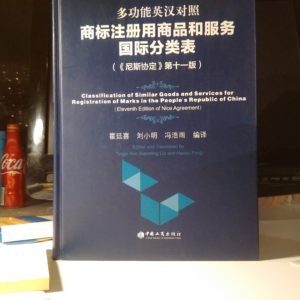
Let’s assume that you have two similar marks; they may sound the same or they may look the same. You next need to determine if they are used on sufficiently related goods as to cause infringement. Here’s where Mr. Huo’s book makes that determination. Say the services at issue are “Providing on-line videos, non-downloadable.” You will find those services in that book, which is in both English and Chinese, on page 345, listed in English in alphabetical order. To the right of that listing of services is a four-digit code, in this case “4105.” Turning to page 599 of Mr. Huo’s book, you will find the start of a little more than one page of related services. These run from “Entertainment service” to “Movie studios services” to “Production of radio and television programmes” to Rental of videotapes” to “Videotaping” to “Production of music,” which is a rather thorough listing of related services, which if sold under the same or similar mark to the one alleged to be infringed for providing on-line videos, would be likely to cause confusion, mistake or deception.
Let’s pick another example, “Mobile Phones.” “Mobile Telephones” may be found on page 317 of the book, to the right of which may be found the code “0907.” That code may be found on pages 478-479 of the book next to such related goods as “Antennas,” “Transmitters of electronic signals,” “Video telephones,” “Navigation apparatus for vehicles,” “Cordless telephones,” “Radio Pagers,” “Satellite navigational apparatus,” [Most smartphones have GPS] and “Wearable activity trackers,” which when used with a mobile phone can transmit notifications from that phone to your wrist.
Or let’s pick an everyday item like Lipstick, found on page 307 of the “book” next to the code “0306.” That code may be found on page 428 of the book next to a host of items generally sold together by the same maker such as “Nail polish,” “Make-up,” “Mascara,” “Lip glosses,” and “Sunscreen preparations.”
Now, what if all of this information was computerized. If software can do voice recognition, you can set up parameters by which that software will determine if two words sound alike, image processing software such as Google Images can determine if two marks look alike and word processing software contains a thesaurus function that determines which words carry the same meaning. Put it all together and in the not too distant future trademark infringement decisions may be rendered by computers eliminating both Patent Office trademark examiners and judges.
